I have just returned from 5 days camping in the White Mountains on the California-Nevada border at 8600 feet and in central Nevada at 7600 feet under good to excellent seeing and transparency. I had ample time to evaluate the Oberwerk 25x100 astronomy binoculars (made in China), using them 3-4 hours each night. The following are my impressions on both the viewing and an evaluation of the the optics and mechanics of the binoculars.
Viewing
I mounted a Telrad finder on top of the binoc . This proved invaluable for locating objects from the horizon to 70 degrees, about the practical limit of elevationof the 28-pound !! binoculars without becoming overly top-heavy on the supplied tripod and alt-azimuth mount.I viewed all the globular clusters brighter than 11.1 mag(NGC 6426...maybe I saw it??) and open clusters listed in the Trion SkyAtlas in the constellations Sagittarius, Scutum, Aquila, and Ophiuchus over a period of three nights. The larger globs revealed structure and partial resolving of the core and halo, providing the stars were 13 magnitude or brighter. A little more magnification on globs would be appreciated, say 30x. However, overall, the tradeoffs between FOV, exit pupil (brightness), and magnification is excellent. The views of the Sagittarius star fields with the dark nebulae was the high point of my observing. WOW!!
On the another two nights I concentrated on the open clusters in Cassiopeia, Perseus, Auriga, Gemini, and Taurus.Additionally, the view of M31 was spectacular! You could trace out the full extent of the arms and the "potato chip effect" of the arm tips was evident to me for the first time since I have observed this object over the last 20 years. M33 revealed its spiral arms with adverted vision. M51 showed both components clearly even at the relatively low power of 25x. M101 (102) was huge in the field. M81 and 82 were well seen in the same field. This, however, is notan instrument for viewing smaller, fainter galaxies, but who cares when it does so many other things well.
Another class of object thatyielded excellent views was the diffuse nebulae such as M8 (Lagoon), M16 (Eagle), M17 (Swan), and M20 (Triffid) in Sagittarius. Also M1, the Helix in Aquarius, NGC 246 in Cetus, and M57 in Cygnus were awesome! There is something about framing these objects with a lot of space around them that makes up for the lack of higher magnification.
The most fun way to observe is to swing azimuth through the Milky Way and then raise the binocular a field and swing back. Objects would show up and then you could look on the chart and find out what it was. Sometimes I didn't care about the NGC label of what I was looking at; stopping to look up the object would spoil the spontaneityof the experience and seemed WAY too anal. OTOH, star hopping with the Telrad to find specific objects was a joy of simplicity, since the views through the binocular is right side up and leftto right correct. The Trion charts along with The Night Sky Observer's Guide (volumes 1,2) and Steven O'Meara's Deep Sky Companions:The Messier Objects were my constant source of reference. Used together, these gave me a comprehensive source of information about the objects possible to see with a 5.6 inch aperture, the equivalent light gathering of a pair of 4 inch refractors. I found that I could go down to 12+ magnitude reliably under the world class skies I was observing from.
Binoculars
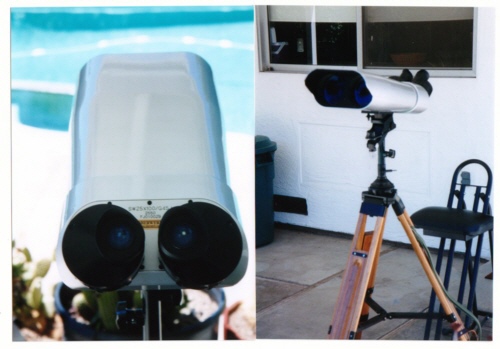
I have a love-hate relationship with these binoculars, but I love them in spite of their failings (read on). This is a lot of glass for the money, and comes complete with a sturdy adjustable wood tripod, alti-azimuth mount to interface the binoculars to the tripod, and a case with wheels and extendable handle with die cut foam for the binoculars and accessories including the mount. The whole assemblage consists of the case (50+ lbs) and tripod (16 lbs) , not exactly grab and go, but simplicity itself compared to my CG 11 with eyepieces and all the support accessories (200+ lbs). All this for around $1600, quite a bargain when you look at the competition with 45 degree oculars.
The objectives are F 5.6 air spaced triplets advertised as "semi-apo". The color correction on axis is in fact quite good, the nearly full moon showed only a thin color fringe on the limb. The oculars are 23mm FL, 5 element Erfles with 14mm eye relief, a 67 degree apparent FOV and the outside diameter of the housings a HUGE 2 inches across!I fact, even with the rubber cups folded back , people with a large nose bridge and narrow eyes (less then 60mm) will have a hard time getting their eyes close enough to the eyepieces to have an unvignetted view. The interpupilary adjustment is nicely done with the ocular housings geared together, allowing the two sides to remain centered during the full range of adjustment (58mm-82mm).
The Love Part
I love the easyuse and the awesome views of the dark nebulae and subtle gradations of star densities in the Milky Way. Looking at 2 ½ degree chunks of sky with the 3D effect of using both eyes is definitely different than the usual narrow field monocular viewing ofparticular objects. I gained a whole new respect for open clusters which I have always viewed rather perfunctorily with telescopes in the past. I also love the 45-degree ocular position,a necessary requirement for my use since I am viewing continuously for several hours on a good night. The tradeoff for this, however, is another prism in the optical chain which adds to the color and aberration of the final image.
The Hate Part
I am less thrilled with the optics, particularly the oculars. The usable critical field in terms of area is about 50%. By "usable" I mean that a close double would still be recognizable two-thirds of the way out from the center of field to the edge. After that, the aberrations increase quickly. The stars at the edge of the fieldstop are unrecognizable as stars; they look like smears of light.I believe you are running into the edges of the prisms at this point. The manufacturers of the binoculars would do well to stop down the field 5+ degrees, which would still yield a respectable 60-degree field of view and clean up a lot of the objectionable images which tend to be distracting. Or increasing the size of the prisms would be even better. If I were to recommend changes to the manufacturers, I would suggest changing out the Erfle design with Plossels to clean up the edge corrections. I would rather have a clean 55 degree FOV than the current 67 degree.
The view through the oculars reminds me of a 1 ¼ inch 20mm Meade Erfle I bought 20 years ago, before Al Negler and Teleview. I nicknamed it the "awful Erfle". It has long ago disappeared into my box of unused stuff. The design is at least 20 years old and has been replaced with much more sophisticated designs (a la Teleview). Also, when viewing a bright star such as Vega, ghosting is evident. Further investigation with a flashlight reveals that at least two of the ocular lens element surfaces are uncoated. When you pay this kind of money ($1600) you have a right to expect better. I have found that Russian optics, and apparently Chinese optics seem to be behind the rest of the world when it comes to coating technology. Although the coatings are advertised as "multicoated", I believe (and other people I trust as knowledgeable agree) that they are in fact simple mag fluoride.
Still ...
In spite of these carps, I would recommend them to anyone on a budget looking for an entre into giant binocular
viewing. I know I'm hooked for good. Using both eyes adds a dimension to viewing that is habit forming. Now if
I could only find a cheap, used pair of 25x125 Fuginons.......
OH WELL......respectfully submitted
Mr. Bill
Addendum 06/05/02

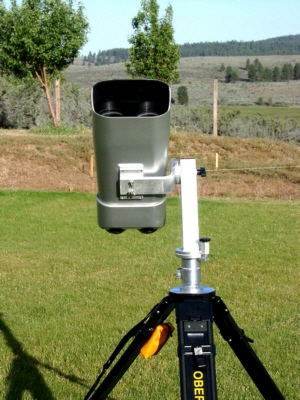
I recently purchased Oberwerk's heavy duty surveyor tripod and the Unistar altazimuth mount made by Universal Astronomics. These have dramatically improved my viewing enjoyment with my 25x100 binoculars.
The standard Chinese mount and tripod that was originally purchased with the
Oberwerk 25x100 binoculars last year (see review under big binoculars)
proved to be marginally acceptable. The binoculars would only elevate to about
75 degrees before running out of travel, not to mention being perilously out
of balance. Any breeze would cause the binoculars to oscillate. The mount's
settling time was several seconds, making use of the binoculars for astronomical
use frustrating.
I am happy to report that Kevin at Oberwerk has come up with the solution of a rock solid mount and tripod combination. This has allowed me to concentrate on observing rather then cussing and fussing with the binoculars. It is COMPLETELY stable in light to moderate winds (5-10 mph) and allows viewing the zenith with aplomb. The mount is said to handle 30 pounds and since the binoculars I am using are 26 pounds, I have no doubt that this claim is accurate.
Since a picture are worth a thousand words, check it out. I am completely happy with the present setup, and I am not easy to please. Enough said.
Mr. Bill
ps. I modified tripod with mounting optional spreader bar in place of safety chain. This greatly improved ease of setting up tripod.